Summary
Self-service kiosk markets are growing at 11–16% CAGR. But every time a staff member is removed from a service encounter, invisible psychological functions disappear with them. The central design challenge of unattended payment is not transaction automation — it is the deliberate reconstruction of the trust and cognitive scaffolding that human staff provided instinctively.
This article identifies five psychological domains that self-service design must explicitly address: perceived control, cognitive load, trust architecture, public-environment pressure, and the asymmetric cost of negative experience.
Introduction
Self-service is not coming. It is already scaling. Depending on how the category is defined, self-service kiosk markets are growing at roughly 10.9% to 16.1% compound annual growth rate [17, 18], with adjacent unattended payment technology showing similar momentum [19, 20]. The business case for removing staff from service encounters is well established. The design case for doing so effectively is not.
Every time a staff member is removed from a service encounter, something disappears that no hardware specification captures: the person who absorbed uncertainty, signalled progress, repaired failures, and provided social permission for a customer to take their time. Those are not features. They do not appear in a procurement brief. But their absence is felt immediately — in hesitation, in abandonment, in the slow erosion of trust that follows a transaction that felt opaque.
This article addresses that gap. It is structured around five psychological domains that self-service design must explicitly inherit from the human staff it replaces: perceived control, cognitive load, trust architecture, pressure in public environments, and the asymmetric cost of negative experience. Each domain is grounded in behavioral psychology research with direct design implications for payment terminals, kiosks, and unattended payment solutions.
The argument is not that staff should be retained. It is that their invisible work must be designed for — deliberately, specifically, and with an understanding of the psychological mechanisms involved. The interfaces that will succeed at scale are the ones that treat this as a primary design requirement, not an afterthought.
This article extends and applies the trust framework developed in the author’s prior work on digital payment experience [1], in which trust is modelled as an emergent property regulated by Sense of Control and constrained by Cognitive Load. The present article examines what that model means in the physical, public, unattended contexts where self-service kiosks operate.
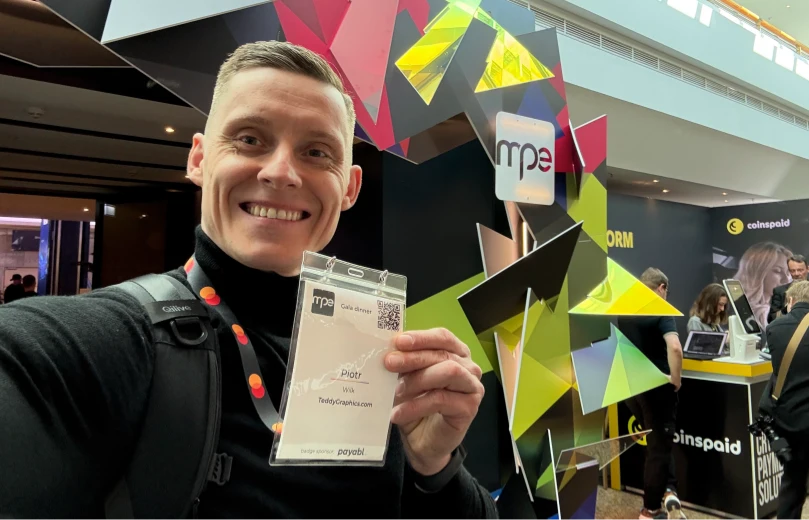
On 18 March 2026 at 13:25, Piotr facilitated a roundtable discussion at the Merchant Payments Ecosystem (MPE) conference in Berlin, where together with payment industry experts he uncovered the findings of TeddyGraphics’ research into the psychology of self-service and unattended payment — the same research this article presents. The photographs below document that session.



Perceived Control
Wait Time Is Psychological, Not Mechanical
In 1984, David Maister published what has become the foundational text on the psychology of waiting lines [2]. His central claim was elegant and counterintuitive: the experience of waiting is not primarily determined by its duration. It is determined by the psychological conditions under which it occurs.
Maister identified eight principles governing perceived wait time. Among the most relevant for unattended payment: unoccupied time feels longer than occupied time; unexplained waits are more frustrating than explained ones; and uncertainty about the length of a wait is more distressing than certainty about a long wait. All three create direct design requirements.
Maister argued that perceived wait time often has a greater impact on satisfaction than actual wait time [3].
A 40-year retrospective of Maister’s work, published in 2025, synthesized nearly 1,500 citations and proposed a significant conceptual refinement: the field should shift focus from perceived waiting time to the “tolerability” of waits, with perceived progress as the central variable [4]. That shift — from measurement to tolerance — is precisely the right frame for unattended payment design.
Designing for tolerable waiting means communicating progress at every non-trivial pause. A spinner with a status message, a transaction step indicator, a confirmation sound on card tap — these are not decorative. They are psychological infrastructure. In their absence, a two-second processing delay becomes an anxiety event. In their presence, a five-second delay is experienced as a normal part of a process the user understands.
The Asymmetry of Uncertainty
Not all uncertainty is experienced equally. Users tolerate process uncertainty — how long will this take? — far better than outcome uncertainty — will this work at all? Did my card charge? Did I lose progress?
The first is a patience problem. The second is a trust collapse.
The design implication is that the highest-priority information to communicate is not duration but status. Not “this will take 8 seconds” but “your card was read, your transaction is processing, you have not lost money.” Each of those confirmations resolves a specific uncertainty that the user is already actively managing.
This maps to the trust model in prior work [1], in which Sense of Control depends on seven conscious-level contributors: legibility, orientation, temporal coherence, reversibility, autonomy-preserving safety, tailoring, and understandable system feedback. Each is a form of uncertainty reduction. Remove them and trust does not weaken gradually — it fails suddenly, because the user’s working model of the situation collapses.
Progress Protection
When a system preserves progress — returning to the payment screen after a timeout rather than resetting entirely, confirming that a selection was registered, remembering a completed step — it communicates something beyond usability. It communicates that the system is working with the user, not merely processing them.
The converse is equally true. When progress is lost without explanation — when a timeout returns the user to the start screen with no acknowledgment of what happened — the user does not experience a neutral reset. They experience a loss. And that response is automatic, affective, and disproportionate to the objective event.
Loss Aversion and the Psychology of Irreversibility
Kahneman and Tversky’s Prospect Theory established that losses are weighted approximately twice as heavily as equivalent gains — a cognitive asymmetry they termed loss aversion [5]. The psychological pain of losing $10 is approximately double the psychological pleasure of gaining $10.
In payment contexts, this asymmetry is structurally important. A failed transaction is not experienced as the neutral absence of a successful one. It is experienced as a loss — of time, of certainty, of confidence in the system. That loss generates emotional weight that cannot be recovered by a subsequent success. The prior work by the author explicitly identifies Reversibility as a conscious-level contributor to Sense of Control for precisely this reason: users are more risk-averse when they perceive that mistakes cannot be undone [1].
Loss aversion also shapes behavior in anticipation of potential loss, before any actual failure occurs. A payment terminal with no clear undo mechanism, no confirmation before final commit, and no visual separation between “I am selecting” and “I am paying” creates latent anxiety throughout the transaction — not because anything has gone wrong, but because the user cannot rule out that something could.
Recovery as Psychological Function
In a staffed environment, a failed transaction is absorbed by a human. They explain what happened, communicate that it is not the customer’s fault, offer a path forward, and — crucially — are present as evidence that the situation is recoverable. The customer does not face the failure alone.
In an unattended environment, none of that happens unless it is designed to happen. When a screen goes blank after a failed card read, or displays an error code with no context, or resets to the start screen without explanation, the user is left alone with their anxiety and a machine that has stopped communicating.
The meaning of failure changes when there is no human nearby to repair it. A recoverable technical error becomes a trust breach. A temporary processing problem becomes evidence that the system is unreliable. Recovery is not a fallback state. It is a primary trust mechanism — and its quality is one of the highest-leverage design decisions in any unattended payment flow.
Cognitive Load
The Paradox of Choice in Service Design
Barry Schwartz’s foundational work on choice overload established that increasing the number of options does not reliably increase satisfaction or ease of decision-making [6]. Beyond a threshold that varies by context and user familiarity, additional options increase cognitive effort, decision fatigue, and regret — and can produce decision paralysis and abandonment.
The standard self-service kiosk design response to user needs has often been to add options: more payment methods, more languages, more categories, more help content. Each addition is defensible in isolation. Cumulatively, they can transform a transaction interface into a cognitive burden.
The precise mechanism is described by Sweller’s Cognitive Load Theory [7], which models working memory as a limited resource. When cognitive demands exceed working memory capacity, users default to heuristic processing — and frequently, to distrust and abandonment. This connection between cognitive overload and trust failure is central to the trust model in prior work [1]: “under perceived effort higher than expected, humans default to distrust.”
Friction Is About Thinking, Not Time
The conventional usability metric for friction is time-on-task. But the evidence from cognitive psychology suggests that friction is more accurately understood as cognitive cost rather than temporal cost. Users abandon not primarily because interactions take too long, but because understanding what to do next requires more mental effort than they are willing to invest in the context where they find themselves.
The distinction matters for design practice. Reducing time-on-task by compressing steps may actually increase cognitive friction if the compression reduces legibility. A two-step checkout that requires the user to interpret an ambiguous screen may be experienced as harder than a four-step checkout in which every screen has a clear, singular purpose.
The operative question is not “how many steps?” but “how much thinking is required at each step?” Designing for comprehension — the active construction of understanding — is a fundamentally different activity from designing for information exposure, which is the passive delivery of data. One serves the user’s cognitive process. The other serves the system’s data requirements.
The Cost of Ambiguity
Ambiguity in unattended interfaces does not produce confusion. It produces abandonment. In a staffed environment, a user who is uncertain can ask. In an unattended environment, the interface is the only source of guidance. If the interface cannot resolve the uncertainty — through clear labeling, appropriate sequencing, or immediate feedback — the user’s only options are to proceed blindly or to leave.
The asymmetry of this situation is easily underestimated in design contexts. Design teams encounter their own interfaces repeatedly, in familiar, low-stakes contexts, with time to reflect. Their users encounter those interfaces once or occasionally, in public, with time pressure, and with real financial stakes. The cognitive cost of ambiguity is not evenly distributed between those two populations.
Trust: The Invisible Architecture
Security Is Not the Same as Feeling Secure
A payment flow can be cryptographically sound, PCI-DSS compliant, and operationally impeccable — and still fail because it does not feel trustworthy. Users do not evaluate security through its technical architecture. They evaluate it through the interface’s behavior: the presence or absence of feedback, the clarity of confirmations, the legibility of what is happening and why.
This is not irrationality. It is a rational inference strategy. Users who cannot directly inspect a system’s security properties use visible design quality as a proxy for underlying reliability. Reber and Schwarz’s processing fluency research established that stimuli which are easy to process feel more true and more trustworthy [8]. A confusing interface does not merely fail usability criteria — it actively signals unreliability.
The Opacity Problem
A highly optimized payment flow can destroy trust even when nothing goes wrong. The mechanism is opacity: when the interface does not communicate what is happening at each stage, the user’s sense of control deteriorates throughout the transaction — not because anything has failed, but because they cannot tell whether it has.
Can a flow be secure in reality but still fail because it does not feel trustworthy? Yes. When a payment is processing, what matters more: actual speed, or the user’s felt sense of control?
The answer is both — but if forced to choose, designing for felt control generates more trust than designing for raw speed. A transaction that takes 4 seconds but communicates progress at each step will consistently outperform a transaction that takes 2 seconds and goes dark. This is consistent with research showing that real-time updates during waits reduce anxiety and increase trust in the service provider [3].
The Continuity of Trust Assessment
The trust model in prior work models trust as emergent, continuous, and comparative — updated throughout the interaction, measured against expectations, and integrating multiple signal types simultaneously [1]. This has a specific implication for unattended payment design: trust is not established at the beginning of a transaction and then held. It is earned and re-earned at every transition.
Each screen transition, each wait state, each confirmation — or absence of confirmation — is a data point in the user’s ongoing trust assessment. A flow that establishes trust early and then becomes opaque at the payment confirmation stage will lose that trust at the worst possible moment. Trust design cannot be front-loaded.
Public-Environment Pressure
Social Facilitation and Its Limits
In 1898, Norman Triplett made an early observation that would define a century of social psychology research: people perform differently when observed by others. Floyd Allport later formalized this as social facilitation [9]. Robert Zajonc’s 1965 synthesis provided the explanatory mechanism: the presence of others increases physiological arousal, which in turn enhances performance on simple or well-practiced tasks and impairs it on complex or unfamiliar ones [10].
A first-time user at an unfamiliar kiosk is the worst-case scenario for this effect. The task is novel. The interface is unfamiliar. The cognitive demands are high. The presence of an audience — even a passive one, simply waiting in a queue — activates arousal that impairs performance on exactly the kind of complex, novel processing the kiosk requires.
Evaluation Apprehension
Cottrell’s model of Evaluation Apprehension [11] refines social facilitation by specifying that performance impairment occurs specifically when an individual believes they are being evaluated. In a queue at a payment kiosk, that condition is almost always met: the people waiting behind are necessarily observing, and the user is necessarily aware of it.
Baumeister’s (1984) research on choking under pressure provides the cognitive mechanism [12]: social pressure increases conscious attention to one’s own performance process, disrupting the automatic execution of familiar actions and severely impeding unfamiliar ones. In a kiosk context, “choking” looks like a stalled interaction, a repeated tap, or an abandoned transaction. The user knew — approximately — what to do. The social context made them uncertain enough to fail.
The behavioral consequence is direct and often underestimated: a significant share of kiosk abandonment is not a usability failure. It is a social failure — the calculation that hesitation in public is more costly than walking away. The interface did not confuse the user. The audience did.
What Users Tolerate in Private, They Refuse in Public
This asymmetry has a critical implication for design practice. Usability testing conducted in a lab environment — seated, unhurried, unobserved, with an understanding that errors are part of the process — substantially underestimates the difficulty of the same interface in a public deployment.
The lab user who hesitates for eight seconds before finding the correct button is experiencing a usability problem. The kiosk user who hesitates for three seconds in the same location is experiencing that usability problem amplified by social pressure, time anxiety, and the physical discomfort of being watched. They will not reach second eight. They will leave at second four.
Public pressure does not merely reveal weak UX. It creates weak UX where none existed in a private context. An interface that performs adequately in testing may fail systematically in deployment simply because of the social conditions of its actual use environment.
Design Principles for Public Environments
These dynamics generate specific design requirements for public-environment interfaces — requirements that are distinct from, and in some ways contrary to, standard usability practice.
Reduce cognitive load below the threshold required for private use. The cognitive budget available to a public kiosk user is smaller than the budget available to a private one, because a portion of their working memory is occupied managing social perception. Interfaces designed for the cognitive budget of a private user will consistently overshoot the available capacity of a public user.
Provide more visible progress feedback, not less. The instinct in unattended design is often to minimize UI complexity by reducing confirmations. In public environments, this instinct must be resisted. Visible progress — clear step indicators, explicit confirmations, auditory feedback — serves a second function beyond usability: it provides social legibility. When a transaction is visibly progressing, the user’s social anxiety is reduced because the interaction is comprehensible to observers as well as to the user.
Make the critical path obvious. The single most common source of public-environment hesitation is the momentary uncertainty about what to do next. The solution is not to add help content — which requires additional cognitive processing — but to design the critical path so that the next action is unambiguous without reading. In a queue context, the interface should be self-explanatory at a glance.
Acknowledge the temporal context. A user who completes a transaction in thirty seconds in a private context will experience that same thirty seconds differently when five people are watching. The interface cannot make the transaction faster, but it can make the time feel purposeful by filling it with visible, meaningful feedback.
Calibrate error recovery for public contexts. In a private context, an error message is a usability friction point. In a public context, it is a social exposure event. The user must be seen to struggle with a machine in front of other people. Error messages in public environments require faster resolution paths, clearer language, and explicit reassurance that the error is common and recoverable — not because the user needs that information more than a private user does, but because their social anxiety amplifies every second they spend on an error screen.
The Failure of Private-Context Testing
The gap between lab performance and deployment performance is one of the most persistent — and most costly — problems in kiosk interface design. Organizations that rely exclusively on usability lab data to validate their interfaces are, in effect, testing a different product than the one they are shipping.
Addressing this requires including social-pressure conditions in usability research. This can take several forms: testing with a visible observer present; testing in situ at actual deployment locations; adding artificial time pressure to lab sessions; or designing specific research scenarios that simulate queue conditions. None of these are perfect substitutes for real-world deployment data, but all of them produce significantly more representative results than a standard lab session.
The investment in more ecologically valid research methods repays itself quickly. A single round of public-environment usability testing typically surfaces abandonment patterns that were invisible in lab conditions — and identifies the specific interface moments where social pressure amplifies hesitation into departure.
The Asymmetric Cost of Bad UX and the Global CX Decline
The 1:12 Asymmetry
Ruby Newell-Legner’s practitioner research documented a striking asymmetry in the recovery mathematics of customer experience: it takes twelve positive experiences to repair the damage done by a single unresolved negative one [13]. This figure is consistent with loss aversion theory — the emotional weight of a negative experience is disproportionate to its objective severity — and with a broader body of psychological research showing that negative affect has stronger and more durable effects than positive affect of equivalent magnitude.
The implication for unattended payment design is direct and sobering. Every abandonment event, every failed transaction, every moment of public hesitation that results in a user walking away is not a neutral data point. It is a negative experience with twelve times the emotional weight of a positive one. The interface that generates one bad experience for every ten good ones is, from the user’s psychological perspective, operating at a net negative.
The Forrester CX Index: A Multi-Year Signal
Forrester’s Customer Experience Index provides the largest longitudinal dataset available on consumer perception of service quality across industries. Its methodology measures three dimensions of experience: Effectiveness (how well a brand helps customers achieve their goals), Ease (how frictionless the interaction feels), and Emotion (how the experience makes customers feel) [14].
The 2025 results are significant. U.S. CX quality fell to a new average low of 68.3 out of 100 — the fourth consecutive year of decline, following three years of steady improvement [15]. Among brands evaluated in both 2024 and 2025, 25% saw statistically significant losses while only 7% improved [16]. The pattern held across most U.S. industries and across all three measurement dimensions simultaneously: effectiveness, ease, and emotion declined together.
That simultaneous decline across all three dimensions is not a coincidence. It is a structural signal.
Three Dimensions, One Architecture
Effectiveness, Ease, and Emotion are not independent dimensions. They are sequentially dependent — and this dependency maps precisely onto the psychological architecture described in this article.
A system that fails on Effectiveness — that does not reliably help users complete their goals — cannot be experienced as Easy, regardless of its interface quality. Cognitive load increases when the user must compensate for system failures. Uncertainty increases when outcomes are unpredictable. Both drive abandonment.
A system that fails on Ease — that generates friction through ambiguity, excess choice, inadequate feedback, or poor recovery from errors — generates emotional friction regardless of whether the transaction ultimately completes. The emotional cost of a transaction is not measured at its outcome. It is accumulated throughout the interaction, at every moment of uncertainty or cognitive effort.
Emotion — the final output of Forrester’s framework — is downstream of the other two. It is the accumulated product of every effectiveness and ease failure the user has encountered. And under loss aversion, those failures weigh more heavily than the successes.
This is precisely why the CX decline is structural rather than incidental. It is the predictable consequence of designing services — including self-service interfaces — without an explicit model of the psychological needs they must meet. The Forrester data is not measuring customer preferences. It is measuring the accumulated effect of systematic psychological design failure.
The Self-Service Amplifier
In a staffed service environment, human staff absorb and compensate for many of the psychological failures described above. A slow response is softened by an explanation. An error is repaired by a person who reassures. A confusing process is navigated by guidance. The emotional damage of service failure is bounded by the human capacity for empathy and recovery.
In an unattended environment, none of that buffering exists. Every psychological failure hits the user directly, without mediation. The self-service interface is not a simplified version of the staffed service encounter. It is a version with all the error-absorbing capacity removed — which means that its psychological design requirements are, in fact, higher than those of the staffed equivalent, not lower.
The companies contributing to the Forrester CX decline are not, primarily, suffering from technical failures. They are suffering from the systematic underestimation of the psychological work their interfaces must do — work that, in previous generations of service design, was done by people.
Design Implications
The five domains described in this article — perceived control, cognitive load, trust, public-environment pressure, and the cost of negative experience — are not independent design problems. They are interconnected expressions of a single underlying requirement: the interface must be worthy of the psychological trust the user places in it.
Several practical implications follow.
The first is that the primary design question for any unattended payment flow is not “does this work?” but “does this feel safe?” Functionality is necessary but not sufficient. The experience must actively communicate competence, progress, and recovery capacity at every stage — not because users are irrational, but because those signals are the only information users have about a system they cannot inspect.
The second is that public-environment testing must be treated as a distinct and mandatory phase of the design process. Interfaces validated only in lab conditions are not validated for their actual use context. The cognitive and social dynamics of public deployment are different enough from lab conditions to require separate evaluation.
The third is that cognitive load reduction must be treated as an architectural constraint, not a cosmetic preference. Every element of the interface that requires interpretation, every choice set that exceeds working memory capacity, every ambiguous label that requires the user to infer meaning — all of these are not minor usability issues. They are structural trust risks, particularly in public-pressure environments where the cognitive budget is already depleted.
The fourth is that error recovery must be designed first, not last. In most interface design processes, the happy path is designed to completion before error states are addressed. For unattended payment flows in public environments, this inversion of priorities produces interfaces that perform well when nothing goes wrong and fail catastrophically when something does — precisely when the interface’s psychological support capacity matters most.
The fifth is that the Forrester CX framework — Effectiveness, Ease, Emotion — is a useful evaluation instrument precisely because its three dimensions map onto the psychological architecture this article describes. Effectiveness corresponds to trust in system reliability. Ease corresponds to cognitive load and perceived control. Emotion is the downstream product of how well both are served. Organizations seeking to improve their CX Index scores should treat these not as separate initiatives but as expressions of a single psychological design problem.
Conclusion
Self-service kiosk design is not primarily an operations problem. It is a trust problem disguised as an operations problem.
The moment we remove staff from a service encounter, we inherit responsibility for every invisible function they were performing. We absorb uncertainty. We communicate progress. We protect users from cognitive overload. We recover from failure without losing the user’s confidence. We give users social permission to hesitate.
None of that is delivered by processing speed, touchscreen responsiveness, or compliance certification alone. It is delivered by deliberate psychological design — by interfaces that have been built with an explicit model of the human needs they must meet.
The technical problem of unattended payment is largely solved. The psychological problem is still open. And the evidence from Forrester’s four consecutive years of CX decline suggests that the gap between technical capability and psychological design quality is widening, not narrowing.
The interfaces that will succeed at scale — in EV charging, vending, parking, car wash, laundromat, and every other unattended use case — are the ones designed with the understanding that the user standing in front of a kiosk is not just a transaction to be processed. They are a person managing uncertainty, cognitive effort, and social exposure simultaneously. Designing well for that person is not a differentiator. It is the work.
References
- P. Wilk, “Trust in Digital Payment Experience: A Behavioural Psychology Framework,” TeddyGraphics Insights, March 2026. [Online]. Available: teddygraphics.com/insights/trust-framework.html
- D. H. Maister, “The Psychology of Waiting Lines,” Harvard Business School Background Note 684-064, Apr. 1984 (revised May 1984).
- A. Arveson, C. Yang, C. Froehle, L. Victorino, M. J. Dixon, and M. Walsman, “40 Years of the Psychology of Waiting: A Celebration and Update of Maister’s Eight Propositions,” SSRN Working Paper 5669790, Sep. 2025.
- D. H. Maister, “The Psychology of Waiting Lines,” in The Service Encounter, J. A. Czepiel, M. R. Solomon, and C. F. Surprenant, Eds. Lexington, MA: Lexington Books, 1985, pp. 113–123.
- D. Kahneman and A. Tversky, “Prospect Theory: An Analysis of Decision under Risk,” Econometrica, vol. 47, no. 2, pp. 263–291, Mar. 1979.
- B. Schwartz, The Paradox of Choice: Why More Is Less. New York, NY: Harper Perennial, 2004.
- J. Sweller, “Cognitive Load During Problem Solving: Effects on Learning,” Cognitive Science, vol. 12, no. 2, pp. 257–285, 1988.
- R. Reber and N. Schwarz, “Effects of Perceptual Fluency on Judgments of Truth,” Consciousness and Cognition, vol. 8, no. 3, pp. 338–342, 1999.
- F. H. Allport, Social Psychology. Boston, MA: Houghton Mifflin, 1924.
- R. B. Zajonc, “Social Facilitation,” Science, vol. 149, no. 3681, pp. 269–274, Jul. 1965.
- N. B. Cottrell, “Social Facilitation,” in Experimental Social Psychology, C. G. McClintock, Ed. New York, NY: Holt, Rinehart & Winston, 1972, pp. 185–236.
- R. F. Baumeister, “Choking under Pressure: Self-Consciousness and Paradoxical Effects of Incentives on Skillful Performance,” J. Personality Social Psychology, vol. 46, no. 3, pp. 610–620, Mar. 1984.
- R. Newell-Legner, Understanding Customers. Ruby Newell-Legner, 2001. [Practitioner research; widely cited in CX industry literature.]
- Forrester Research, “Forrester’s CX Index Methodology: Measuring Ease, Effectiveness, and Emotion,” Forrester.com. [Online]. Available: https://www.forrester.com
- Forrester Research, “Average US CX Index Performance Falls for Fourth Consecutive Year,” Forrester Report RES186162, Jun. 2025.
- Forrester Research, “Forrester’s 2025 Global Customer Experience Index Rankings: 21% of Brands Declined, 6% Improved, and 73% Remained Unchanged,” Press Release, Jun. 24, 2025. [Online]. Available: https://investor.forrester.com
- Grand View Research, “Self-Service Kiosk Market Size, Share & Trends Analysis Report,” grandviewresearch.com, 2024. Global market valued at $34.36B in 2024, projected to reach $62.46B by 2030 (10.9% CAGR); broader self-service technology category from $34.03B (2022) to $92.24B by 2030 (13.8% CAGR). [Online]. Available: https://www.grandviewresearch.com/industry-analysis/self-service-kiosk-market-report
- Technavio, “Self-Service Kiosk Market Size & Industry Analysis,” technavio.com, 2025. Projects 16.1% CAGR from 2026–2030 depending on market definition. [Online]. Available: https://www.technavio.com/report/self-service-kiosk-market-size-industry-analysis
- GlobeNewsWire, “Self-Service Payment Kiosks Market Analysis Report 2025–2030: AI and Machine Learning Integrations Revolutionizing Self-Service Kiosks for Enhanced User Experience,” Aug. 25, 2025. Projects global self-service payment kiosks segment growing at 6.03% CAGR (2024–2030). [Online]. Available: https://www.globenewswire.com/news-release/2025/08/25/3138239/28124/en/Self-Service-Payment-Kiosks-Market-Analysis-Report-2025-2030-AI-and-Machine-Learning-Integrations-Revolutionizing-Self-Service-Kiosks-for-Enhanced-User-Experience.html
- Grand Research Store, “Global Unattended Payment Solution Forecast Market,” grandresearchstore.com, 2025. Points to continued double-digit-range growth in unattended payment solutions depending on category scope. [Online]. Available: https://www.grandresearchstore.com/machines/global-unattended-payment-solution-forecast-market
About the Author
