Summary
Trust in Digital Payment Experience is an emergent Feeling, that:
- arises from Assessment (based on Expectations & Past Experiences),
- is regulated by Sense-of-Control (being the Primary Regulatory Variable),
- gets constrained by Cognitive Load.
How Trust in Digital Payment Experience Gets Modelled:
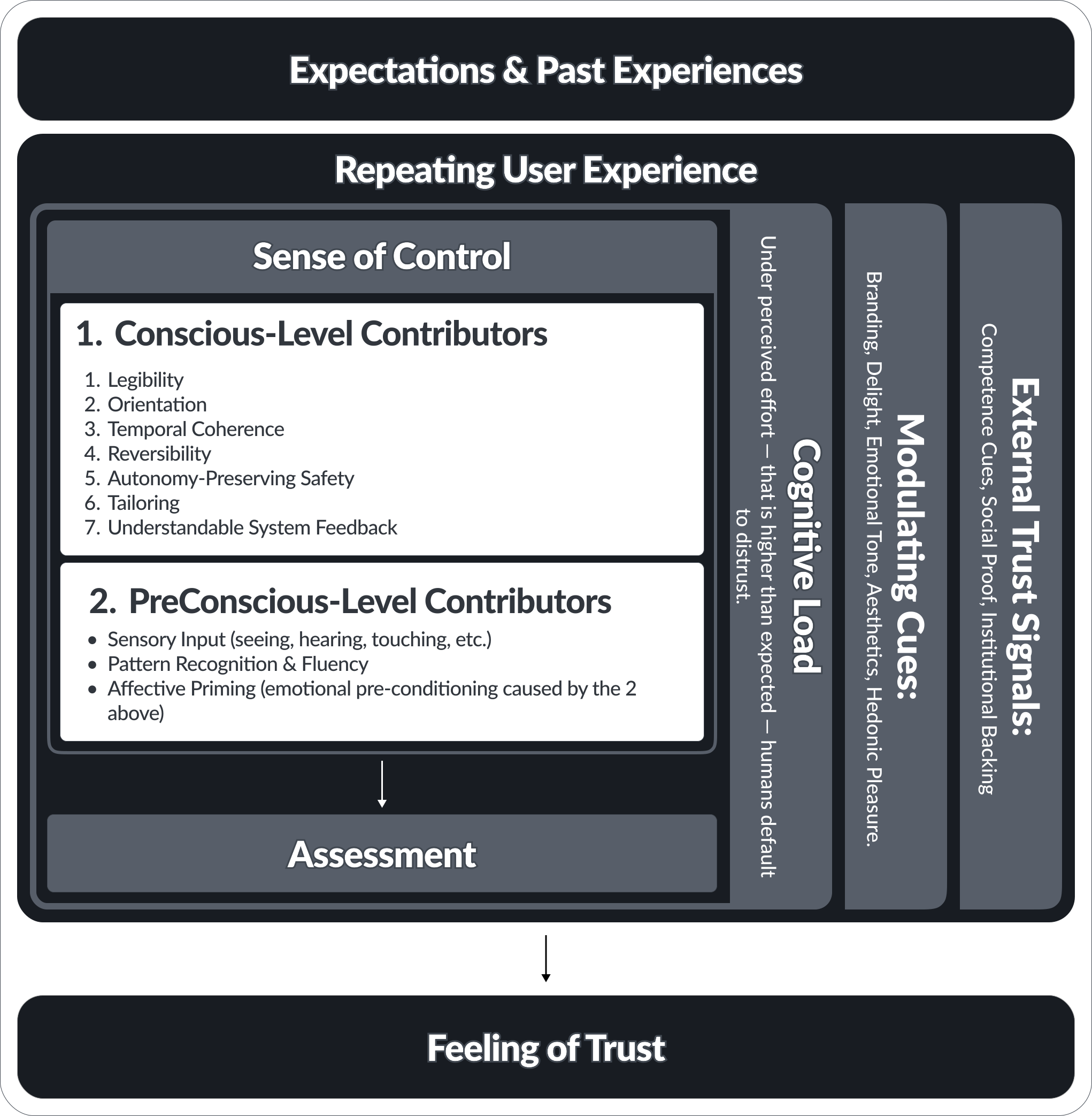
Play with the Interactive Model (opens in a new tab)
The Psychological Foundations
Expectations & Past Experiences
Users do not approach payment interfaces as blank slates. Every interaction is filtered through prior experiences and learned expectations. This aligns with Vroom's Expectancy Theory [1], which posits that motivation (and by extension, willingness to trust) stems from beliefs about whether actions will lead to desired outcomes.
In payment UX, this manifests as:
- Recognition of familiar interface patterns
- Expectations about transaction speed and feedback
- Prior experiences with the brand or similar services
Sense of Control: The Primary Regulatory Variable
The framework positions Sense of Control as the dominant regulatory variable—and research supports this claim strongly.
Rotter's Locus of Control theory [2] established that individuals who believe they can influence outcomes (internal locus) demonstrate greater engagement, persistence, and trust. Those who perceive outcomes as externally determined show reduced trust and increased anxiety.
Deci and Ryan's Self-Determination Theory [3] further identifies autonomy as one of three basic psychological needs essential for well-being. When users feel they are choosing their behaviour rather than being controlled, they experience greater psychological comfort—a precondition for trust.
The framework operationalizes Sense of Control through seven conscious-level contributors:
- Legibility — Can users read and understand what's presented?
- Orientation — Do users know where they are in the process?
- Temporal Coherence — Does the sequence of events make logical sense?
- Reversibility — Can mistakes be undone?
- Autonomy-Preserving Safety — Are users protected without feeling coerced?
- Tailoring — Does the experience adapt to user needs?
- Understandable System Feedback — Does the system communicate clearly?
Cognitive Load: The Trust Constraint
Sweller's Cognitive Load Theory [4] demonstrates that working memory has limited capacity. When cognitive demands exceed this capacity, people default to heuristic processing—and often, to distrust.
The framework's statement that “under perceived effort that is higher than expected, humans default to distrust” aligns with dual-process theory [5]. When System 2 (deliberative thinking) is overwhelmed, System 1 (intuitive, fast processing) takes over. If the intuitive assessment encounters friction or confusion, the default response is caution—distrust.
This has direct implications for payment UX: complexity is not neutral. It actively erodes trust.
Preconscious-Level Contributors
Trust formation begins before conscious thought. The framework identifies three preconscious mechanisms:
Sensory Input
Visual, auditory, and haptic signals are processed immediately upon interface exposure. These create the raw material for trust assessment.
Pattern Recognition & Fluency
Reber and Schwarz's research on processing fluency [6] demonstrates that stimuli which are easy to process feel more true, more likeable, and more trustworthy. The mere exposure effect [7] shows that familiarity—even without conscious recognition—increases positive affect.
For payment interfaces, this means:
- Familiar layouts process more fluently
- Consistent visual language reduces cognitive friction
- Recognition of standard patterns (card input fields, security badges) triggers positive affect
Affective Priming
Zajonc's Affective Primacy Hypothesis [8] established that emotional reactions can occur before—and independent of—cognitive processing. Murphy and Zajonc [9] demonstrated that subliminally presented affective primes influence subsequent judgments even when participants cannot consciously identify the prime.
In payment UX, this explains why:
- Brand associations carry emotional weight before users read any text
- Colour, typography, and imagery create immediate emotional context
- Previous experiences with similar interfaces prime current reactions
External Trust Signals
The framework identifies three categories of external signals that influence trust assessment:
Competence Cues
Mayer, Davis, and Schoorman's integrative model of organizational trust [10] identifies ability (competence) as one of three core antecedents of trustworthiness. Users assess whether the system appears capable of performing the required transaction reliably.
Competence cues include:
- Professional visual design
- Error-free copy and interactions
- Appropriate security indicators
- Clear transaction confirmation
Social Proof
Cialdini's research on influence [11] established social proof as a fundamental principle of persuasion. When uncertain, people look to others' behaviour for guidance.
In payment contexts:
- User reviews and ratings
- Transaction volume indicators (“10 million users trust us”)
- Endorsements from recognized entities
Institutional Backing
Trust transfer from established institutions reduces uncertainty. Bank logos, regulatory compliance marks, and partnerships with recognized brands provide borrowed credibility.
Modulating Cues
The framework distinguishes between core trust mechanisms and modulating cues—factors that amplify or dampen the trust signal without fundamentally generating it:
- Branding — Consistent identity signals reliability
- Delight — Positive micro-interactions create goodwill
- Emotional Tone — The affective character of the experience
- Aesthetics — Tractinsky's research [12] demonstrates that attractive interfaces are perceived as more usable
- Hedonic Pleasure — Enjoyment of the interaction itself
These cues matter most at the margins. They cannot compensate for broken core mechanisms, but they can enhance or undermine an otherwise functional experience.
The Assessment Process
All inputs—conscious contributors, preconscious signals, external cues, and modulating factors—flow into an assessment process. This assessment is:
- Continuous — Updated throughout the interaction
- Comparative — Measured against expectations
- Integrative — Combining multiple signal types
The assessment produces the emergent feeling of trust—not a calculated decision, but an affective state that influences behaviour.
Implications for Design
Prioritize Control
Since Sense of Control is the primary regulatory variable, design decisions should be evaluated against this criterion first. Ask: “Does this increase or decrease the user's sense of control?”
Manage Cognitive Load Ruthlessly
Every unnecessary element, every ambiguous label, every unexpected behaviour adds cognitive load. The framework suggests this directly constrains trust capacity.
Design for Preconscious Processing
First impressions are not conscious decisions. They are preconscious affective reactions. Visual design, interaction patterns, and brand presentation must work at this level.
External Signals Are Not Optional
Competence cues, social proof, and institutional backing are not decorative. They are functional trust mechanisms, particularly important for new users or unfamiliar contexts.
Modulating Cues Refine, Not Replace
Branding and aesthetics matter, but they cannot substitute for functional trust mechanisms. A beautiful interface that violates user control expectations will not be trusted.
Reversibility and Loss Aversion
The inclusion of Reversibility as a conscious-level contributor deserves special attention. Kahneman and Tversky's Prospect Theory [13] established that losses loom larger than equivalent gains—a phenomenon known as loss aversion.
In payment contexts, irreversibility represents potential loss. Users are more risk-averse when they perceive that mistakes cannot be undone. Providing clear undo mechanisms, confirmation steps, and recovery paths directly addresses this psychological reality.
Conclusion
Trust in digital payment experience is not a feature to be added. It is an emergent property of the entire system—arising from how well the experience supports psychological needs for control, minimizes cognitive burden, and provides appropriate signals of competence and reliability.
This framework provides a structured approach to understanding and designing for trust. Each component maps to established behavioural psychology research, offering both theoretical grounding and practical guidance.
The goal is not merely to make users feel trusted, but to create experiences worthy of trust.
References
- V. H. Vroom, Work and Motivation. New York, NY, USA: Wiley, 1964.
- J. B. Rotter, “Generalized expectancies for internal versus external control of reinforcement,” Psychological Monographs: General and Applied, vol. 80, no. 1, pp. 1–28, 1966.
- E. L. Deci and R. M. Ryan, Intrinsic Motivation and Self-Determination in Human Behavior. New York, NY, USA: Plenum, 1985.
- J. Sweller, “Cognitive load during problem solving: Effects on learning,” Cognitive Science, vol. 12, no. 2, pp. 257–285, 1988.
- D. Kahneman, Thinking, Fast and Slow. New York, NY, USA: Farrar, Straus and Giroux, 2011.
- R. Reber and N. Schwarz, “Effects of perceptual fluency on judgments of truth,” Consciousness and Cognition, vol. 8, no. 3, pp. 338–342, 1999.
- R. B. Zajonc, “Attitudinal effects of mere exposure,” Journal of Personality and Social Psychology, vol. 9, no. 2, pt. 2, pp. 1–27, 1968.
- R. B. Zajonc, “Feeling and thinking: Preferences need no inferences,” American Psychologist, vol. 35, no. 2, pp. 151–175, 1980.
- S. T. Murphy and R. B. Zajonc, “Affect, cognition, and awareness: Affective priming with optimal and suboptimal stimulus exposures,” Journal of Personality and Social Psychology, vol. 64, no. 5, pp. 723–739, 1993.
- R. C. Mayer, J. H. Davis, and F. D. Schoorman, “An integrative model of organizational trust,” Academy of Management Review, vol. 20, no. 3, pp. 709–734, 1995.
- R. B. Cialdini, Influence: The Psychology of Persuasion. New York, NY, USA: Harper Business, 1984.
- N. Tractinsky, A. S. Katz, and D. Ikar, “What is beautiful is usable,” Interacting with Computers, vol. 13, no. 2, pp. 127–145, 2000.
- D. Kahneman and A. Tversky, “Prospect theory: An analysis of decision under risk,” Econometrica, vol. 47, no. 2, pp. 263–291, 1979.
About the Author
